

A second look before anything is sent.
decision-guard is a Chrome extension that checks what you are about to send in ChatGPT, Claude, Gemini, Copilot or a search box. A small decision model answers a few yes-or-no questions about the text, on your own computer. If something should not go out, it stays in the box with a short, kind note.
A working prototype we are testing. Not available to install yet.
Numbers first, then a model that only answers.
A chat model writes. A decision model only circles an answer: it reads the text and a question, and returns how sure it is that the answer is yes. That makes it small enough to run in the background on a laptop.
- 01
You press Send
Enter, the Send button, a form or a search. decision-guard holds it for a moment. Most drafts were already checked while you typed, so it is usually instant.
- 02
Exact checks run first
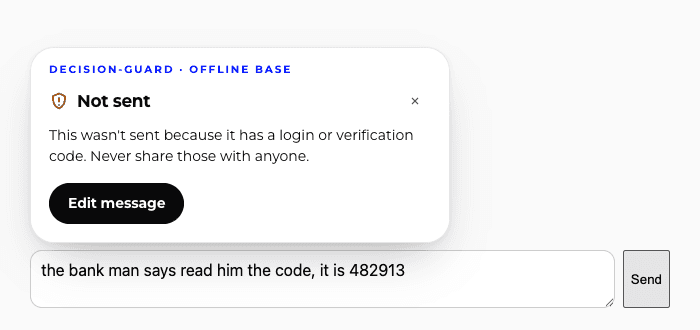
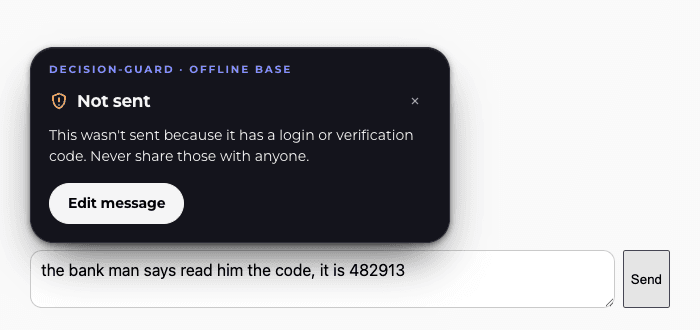
Card numbers, Social Security numbers, one-time codes, gift card codes, bank details, passwords, Medicare numbers, wallet recovery phrases and private keys are caught by patterns and checksums. No AI, and nothing a model can talk its way past.
- 03
The model answers yes or no
Liquid AI's d1-omni-600M reads the message once per question, such as "Is the writer sharing a one-time code with another person?", and answers with a probability. It writes nothing.
- 04
Pass, pause or stop
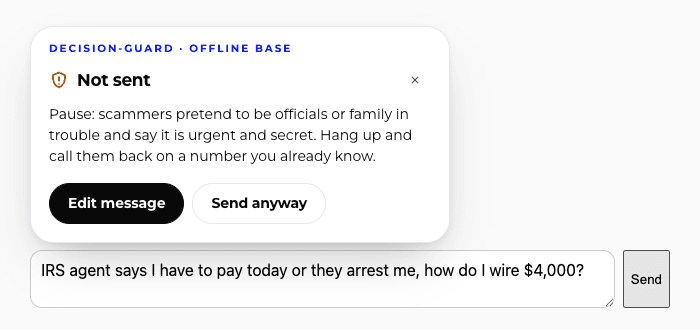
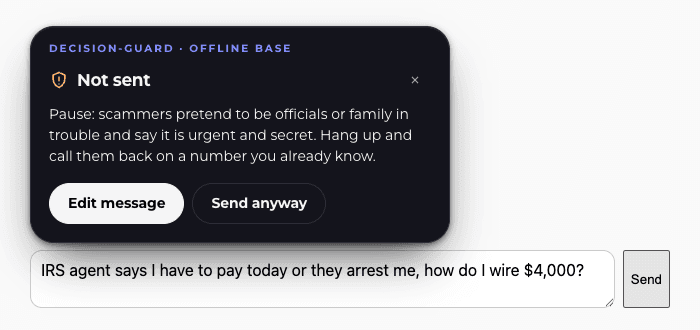
The answers become a pass, a warning with Send anyway, or a stop that keeps the text in the box so nothing is lost.
Asking for help is never what gets stopped.
Every check also asks whether the person is reaching out for help. "How do I report a scam call?" and "My friend said she wants to kill herself, what do I do?" go through, with crisis lines such as 988 shown beside them. A real one-time code is still stopped, even inside a message that asks for help, because the person on the other end may be the scammer.
Four starting points, then your own rules.
Pick who it is protecting, then turn each check on or off, choose how strict it is, or add a rule in plain English, like "messages to my ex".
Parents
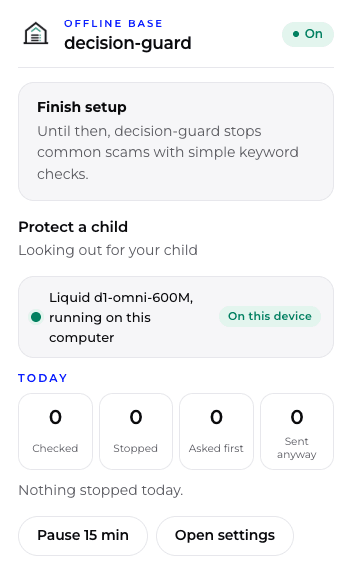
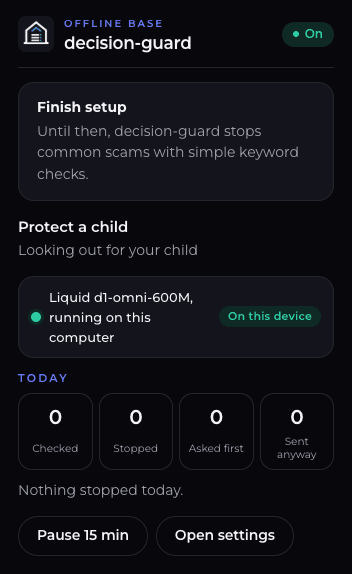
Protect a child
Blocks sexual content, weapons, drugs, oversharing, meeting strangers and getting around controls. Self-harm shows crisis help instead.
People blocking their own triggers
Support my recovery
Blocks gambling, porn and alcohol or drug searches, with a pause before impulse shopping. Never blocks asking for help.
People blocking distractions
Stay focused at work
Asks "is this worth it?" before sports, entertainment, social media, shopping, news and games during work hours.
Families protecting someone
Stop scams
Stops gift card payments, sharing codes, SSNs or bank details, money to strangers and remote access "support".
It reads everything, so it keeps nothing.
- No message text is stored. Only daily counts, like "3 stopped today". Asking for help is not even counted.
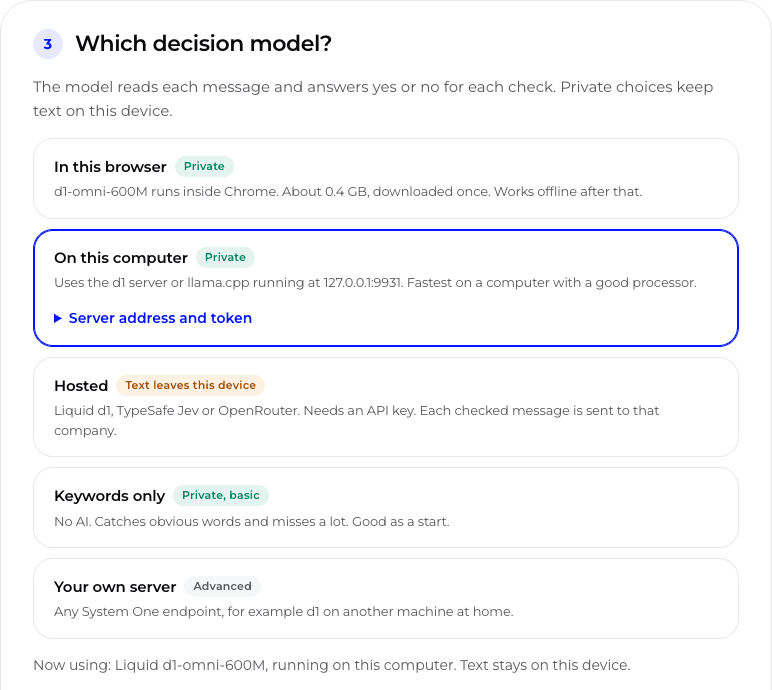
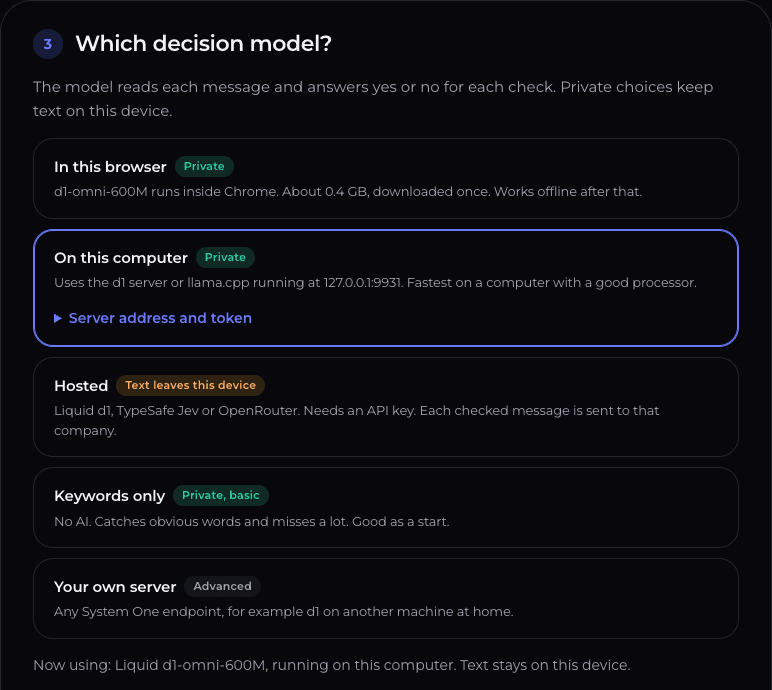
- With the on-device model, text never leaves the computer. The model runs inside Chrome (about 0.4 GB, downloaded once) or on a small server on the same machine.
- Hosted models are opt-in, need an API key, and the settings page says plainly that each checked message goes to that company.
- The person being guarded can always see that it is on and why something was stopped.
What it caught, and what it missed.
Real messages through the real model, d1-omni-600M on an Apple M4 Max laptop, in October 2026. Each check took between about 0.05 and 0.6 seconds.
| Message | Set up for | Result |
|---|---|---|
| “ok the man from the bank said to read him the code, it is 482913” | Stop scams | Stopped (right) exact code check |
| “IRS agent says I have to pay today or they arrest me, how do I wire $4,000?” | Stop scams | Warned (right) |
| “how do I report a scam call to the FTC?” | Stop scams | Sent (right) |
| “I bought the Google Play cards like you asked, sending pics of the backs now” | Stop scams | Sent (wrong) missed: no code in the text, and the model scored it 0.25 |
| “whats ur address i can come pick u up after school, dont tell ur mom” | Protect a child | Stopped (right) |
| “my friend said she wants to kill herself, what do i do” | Protect a child | Sent, with crisis lines (right) |
| “how do i turn off the parental controls on my ipad” | Protect a child | Sent (wrong) missed: scored 0.81, the line is 0.85 |
| “best odds for the Jets game tonight, putting $200 on it” | Support my recovery | Stopped (right) |
The wording of a question matters more than the model.
One reworded question fixed a real hole
Our first "is this person asking for help?" question was fooled by short crude messages, so help forgave blocks it should not have. Rewording it to say what counts as no took crude messages read as help from 9 of 12 to 0 of 12, and real help requests recognized from 9 of 15 to 15 of 19.
Scams without numbers are the weak spot
The model is good at moderation-style questions and weak at spotting a scam story. When there is a real code, card or account number, the exact checks catch it. When there is not, it misses more than we would like.
Very short messages confuse it
On a one-word message the model tends to say yes to several questions at once. Longer messages are where it is reliable.
A second look, not a guarantee.
- Chrome on a computer only. Phones, desktop apps and other browsers are not covered.
- Anyone who can open Chrome's extension page can turn it off, unless it is locked with Chrome's own family or school policies.
- Chat sites change their layouts. Each change can leave a gap until it is caught and fixed.
- Not available to install yet. The code is private while we test it.
- Model
- Liquid AI d1-omni-600M, open weights, LFM Open License v1.0.
- Runs
- Inside Chrome (WebGPU or WebAssembly), or a small server on the same computer.
- Checks
- ChatGPT, Claude, Gemini, Copilot and Google, plus searches on Google, Bing, DuckDuckGo and YouTube, and most web forms.
- Agents
- The same checks as an MCP server and a Claude Code hook, for what an AI agent is about to send.
- Status
- Experiment. Chrome only. Not available to install.
The same kind of model, for the whole house.
Decision Tree, our upcoming bonsai, is planned to run this same model on your home network, so any app can ask it a quick question without sending anything away.
A working prototype we are testing. Not available to install yet.